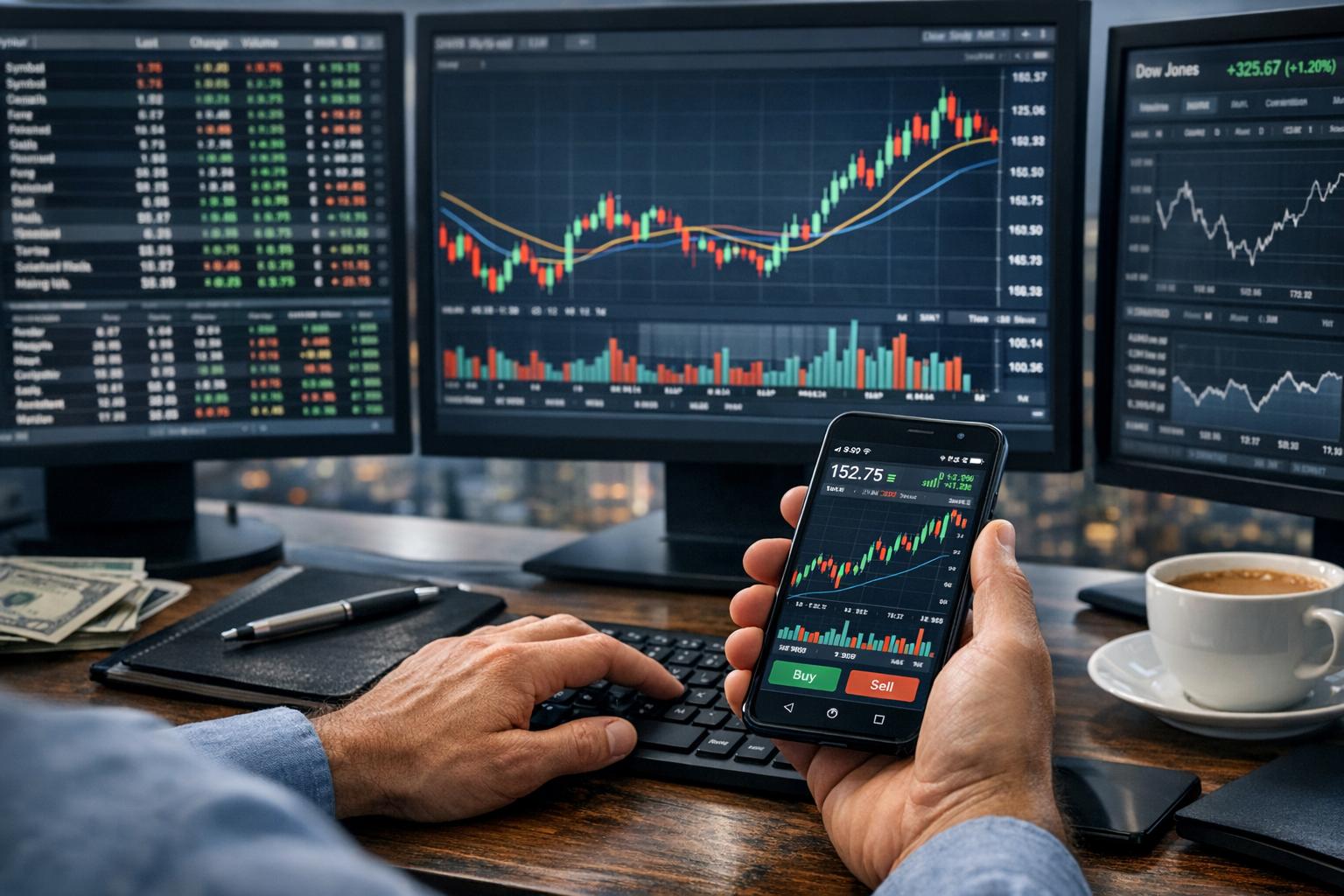
Stock trading sounds simple when you say it out loud: buy a share, sell a share, repeat until… well, until your life choices start looking suspiciously like spreadsheets. The reality is more structured and more consequential. Stock trading is a way investors exchange cash for ownership stakes in public companies, and those ownership stakes move in price because of changing expectations about the future.
This article breaks down how stock trading works in practice: how trades get executed, how markets function, what brokers actually do, how investors approach risk, and why taxes and regulations matter. If you already have basic knowledge (you can tell a stock from a bond and you’ve bought something online before), you’ll find the useful parts here: the mechanics, the common pitfalls, and the concepts that keep showing up when people try to trade and then wonder why reality didn’t follow the plan.
Understanding Stock Trading
Stock trading is the buying and selling of shares issued by publicly listed companies. A share represents a fractional ownership claim in the company. When investors buy shares, they are acquiring exposure to the company’s future earnings, assets, and growth prospects.
Trading happens on financial markets that match buyers and sellers. Prices aren’t fixed; they move constantly as participants react to new information. That information can be company earnings, economic indicators like inflation or employment, interest rate expectations, or even geopolitical news that changes risk appetite. Some days the market moves because the world changed. Other days it moves because the market decided it might.
Stocks can offer returns through price appreciation and dividends. But markets can also move against you fast. A position that looks reasonable based on yesterday’s headlines can look less reasonable after today’s earnings call, a product announcement, or regulatory action.
What a “Share” Really Represents
It helps to be precise about what you own. Usually, common stock provides voting rights (sometimes limited, sometimes not symmetrical), and it may entitle the holder to dividends if the company declares them. But the market value of your shares depends less on what the company says it will do and more on what investors collectively believe will happen.
In practical terms, your return comes from:
- Price changes between purchase and sale.
- Dividends, if the company pays them.
- Splits or corporate actions, which can change share quantity without necessarily changing total value.
There’s a bright side here: owning shares gives you a way to participate in corporate growth. The not-so-bright side is that growth expectations can evaporate quickly when the market revises its forecast.
How Stock Markets Operate
Most stock markets work like large, continuous auctions. Investors place orders, and the market matches bids (buy prices) with asks (sell prices). The matching process relies on order books and execution rules defined by the trading venue.
Market Orders vs. Limit Orders
Two order types show up constantly:
Market order: You agree to trade immediately at the best available price.
Limit order: You set a maximum purchase price (or minimum sale price). The trade executes only if the market reaches your limit.
Market orders help you get filled quickly, which matters if you’re exiting or entering during active trading. Limit orders help you control price, which matters if you’re trading around levels where spreads widen or liquidity thins out.
Liquidity and Why It Matters to Ordinary People
Liquidity is the ability to buy or sell a stock without causing a large price impact. In a practical sense, liquidity affects the difference between the bid and ask—often called the spread. High-liquidity stocks usually have narrower spreads, meaning you tend to pay less extra cost when you enter or exit.
If you trade lightly followed stocks, your order may sit in the book longer, and your eventual execution price might be less favorable than expected. That’s not a moral failing; it’s just math and market structure.
Who Actually Trades
It’s easy to picture a market as “people buying stocks.” In reality, there are multiple participant types:
- Retail investors (individual traders and long-term investors).
- Institutional investors (mutual funds, pension funds, insurance companies).
- Market makers, which quote buy and sell prices to provide liquidity.
- Algorithmic and high-frequency traders, which execute using automated strategies.
Market makers play a practical role: by quoting both sides, they increase the odds your trade gets filled without you waiting around for someone else to show up.
Regulation and Market Integrity
Stock markets operate under rules designed to protect investors and preserve confidence. In the United States, the Securities and Exchange Commission (SEC) oversees securities markets and enforces disclosure and anti-fraud laws. Similar regulators operate globally.
Regulation matters because stock trading depends on trust. If companies weren’t required to disclose material information, price discovery would become guesswork dressed up as “valuation.”
Primary and Secondary Markets
Stock trading appears in different places depending on whether shares are newly issued or already circulating.
Primary Market: When Companies First Sell Shares
The primary market is where companies issue new shares. A common example is an IPO (initial public offering). In an IPO, the company raises capital by selling newly created shares. Underwriters help structure the offering and manage investor demand.
In a healthy primary market, the company gets funding for long-term growth, while investors gain an opportunity to buy into the company’s future. In an unstable one, people can get stuck paying too much for optimism. (History has provided more than a few case studies here.)
Secondary Market: Trading Among Investors
The secondary market is where investors buy and sell existing shares among each other. The company doesn’t automatically receive money from each trade. But secondary trading still matters a lot because it affects pricing and liquidity.
This is where price discovery happens: investors continuously incorporate information into stock values. If you’ve ever watched a stock gap up after earnings, you’ve already seen price discovery at work.
Investment Strategies in Stock Trading
People trade stocks for different reasons, and their time horizons shape their strategy. Time horizon is not just a preference; it heavily influences which signals matter and how risk shows up.
Long-Term Investing and Fundamental Analysis
Long-term investing usually means holding shares for years. Investors typically focus on fundamental analysis, which evaluates the company’s financial condition and growth prospects.
Fundamental investors often look at items like:
- Revenue growth trends
- Margins and profitability
- Debt levels and cash flow
- Management quality and business model durability
Some investors also use valuation metrics such as the P/E ratio (price-to-earnings). A higher P/E can indicate expectations for faster growth, while a lower P/E can mean the market is more skeptical. Either way, P/E is not a crystal ball; it’s a snapshot of what the market currently thinks.
Short-Term Trading and Technical Analysis
Short-term trading targets price movements over shorter periods—days, sometimes minutes. Many short-term traders rely on technical analysis, which interprets price and volume behavior.
Technical analysis often includes:
- Trend identification using moving averages
- Support and resistance levels
- Momentum indicators tied to recent price changes
- Volume to judge whether a move has participation
The practical idea is simple: markets reflect crowd behavior. Technical traders try to read that behavior through charts. The less comforting part is that charts don’t prevent sudden news events from breaking patterns.
Dividend Investing and Total Return
Dividend investing focuses on stocks that pay regular cash dividends. Dividends can provide income while you wait for share prices to move. But dividend investors still care about total return, not just cash payments.
A dividend yield that looks great can be misleading if earnings are unstable or if the payout becomes at risk. Durable dividends tend to align with consistent cash generation, not just accounting optimism.
Risk and Return
Every trader learns this eventually: markets do not run on intentions. They run on information and expectations, and those can change faster than your thesis can be rewritten.
Types of Risk
Market risk (sometimes called systematic risk) refers to risk that impacts broad market conditions. When economic expectations shift, many stocks move together.
Company-specific risk (also called unsystematic risk) relates to problems or opportunities affecting one issuer, such as:
- Guidance changes
- Operational issues
- Regulatory outcomes
- Product successes or failures
Company-specific risk often offers more opportunity for differentiated returns, but it’s also where investors can get blindsided by events they didn’t model.
Diversification and Why It Doesn’t Remove Risk
Diversification means spreading exposure across sectors, industries, and regions. The goal isn’t to make risk disappear—it’s to reduce the damage from one company or theme going wrong.
That said, diversification isn’t magic. If a recession hits widely, your entire portfolio can still drop. Diversification is about smoothing outcomes, not guaranteeing survival.
The Risk-Return Tradeoff
Stocks have historically offered higher long-term average returns than cash or short-term bonds, but they can fall sharply. The tradeoff is volatility. A portfolio that’s designed to tolerate small swings may perform poorly when markets start moving like they forgot the brakes exist.
So risk tolerance matters. A lot of people say they want “growth,” but then they panic when growth stocks reprice through a macro cycle. You can’t fix that mismatch after the fact.
Fundamental Analysis
Fundamental analysis aims to estimate what a company is worth and compare that to its market price. “Intrinsic value” is the term people use, which basically means value based on fundamentals rather than hype.
Financial Statements: What to Look For
Public companies generally publish:
- Income statement (profitability over time)
- Balance sheet (assets, liabilities, liquidity position)
- Cash flow statement (how cash is generated and used)
Investors use these to assess whether reported earnings translate into real cash and whether the business has the financial flexibility to handle downturns.
Profitability, Growth, and Valuation
Revenue growth can suggest market demand or product traction, but it’s not enough on its own. Margins indicate efficiency and pricing power. Cash flow matters because expenses and investment needs show up there, and cash is what ultimately funds operations and growth.
Valuation metrics like the P/E ratio or price-to-sales are tools for comparing the market’s expectations with the company’s current performance. A stock trading at a high multiple typically implies the market expects better growth or more reliable earnings than peers.
Qualitative Factors and Business Durability
Numbers tell part of the story. Qualitative analysis tries to answer questions like:
- Does the company have a credible competitive advantage?
- Is the industry structured in a way that supports stable profits?
- Do management decisions improve the business, or just impress slide decks?
Some investors use the idea of economic moats—durable advantages that help a company defend margins over time. You don’t need the label, but you do need the substance behind it: customer stickiness, switching costs, brand strength, regulatory barriers, or cost advantages that competitors can’t copy quickly.
Technical Analysis
Technical analysis looks at market data—price and volume—to infer the balance of power between buyers and sellers. It doesn’t require knowing the company’s product roadmap. It assumes that the market already reflects available information in price.
Charts and Time Frames
Charts show price behavior across different time frames. A trader may use a 5-minute chart to time entries while a swing trader uses daily charts. The “right” time frame depends on the strategy and the liquidity you’re trading.
Moving Averages and Trend Signals
Moving averages smooth out price data to highlight trends. A common usage is comparing short-term averages with long-term averages. If the short-term average rises above the long-term average, a trader might interpret it as an uptrend gaining strength. If it falls below, they might look for weakness.
Moving averages don’t predict the future—they lag. That’s the tradeoff. They confirm what the market is doing rather than trying to guess what it will do next.
Support, Resistance, and Volume
Support is a price area where buyers historically show up. Resistance is where sellers historically show up. These levels can break, and when they do, traders often react quickly.
Volume helps confirm whether a move has participation. A price increase with low volume can be less convincing than one with strong trading activity. Still, volume is not a guarantee—thin trading can make volume signals unreliable.
Limits of Technical Analysis
Technical analysis does not protect you from unexpected events. Earnings surprises, regulatory decisions, and unexpected macro data can cause gaps that skip over established levels. If your strategy depends on levels that never update in real time, you can run into problems.
In other words: charts help you manage probability. They don’t eliminate uncertainty. Anyone who claims otherwise is either selling something or selling a dream.
Role of Brokers and Trading Platforms
Most investors don’t trade directly with an exchange. They trade through brokers. A broker routes orders to the market and handles account management. With modern online platforms, you also get tools such as watchlists, charting, order tickets, and reporting.
Order Execution and Costs
When you place a trade, you’re paying for execution. Costs can include:
- Commissions (where applicable)
- Bid-ask spread (your real trading cost even when commissions are “zero”)
- Slippage, which happens when execution occurs at a worse price than expected due to fast market movement
Some brokers structure pricing through other mechanisms (often described in broad terms like order routing arrangements). What matters to the trader is the effective cost—how much you actually pay compared to the quoted price.
Broker Selection Criteria
Many buyers focus only on account fees and forget risk basics. A reasonable broker evaluation includes:
- Trading costs and transparency
- Order types and reliability during volatile markets
- Account security measures
- Regulatory standing in your region
- Reporting quality for taxes and recordkeeping
Even a good trading strategy can get wrecked by poor execution. If the platform consistently fills orders at surprising prices, you won’t notice until your results look… “interesting.”
Market Indexes and Benchmarks
Indexes aggregate the performance of selected stocks. They give traders and investors reference points for “the market” without buying every company in it.
Common Indexes
In the US, large benchmark indexes include the S&P 500, Dow Jones Industrial Average, and Nasdaq Composite. Each index has its own construction rules, so performance differences don’t always mean “one is better.” They often reflect different stock weights and sector exposures.
Index Funds and ETFs
Index funds and ETFs allow investors to hold diversified baskets that track an index. These products typically reduce single-stock risk because you own many securities at once.
For long-term investors, diversified funds often fit naturally into a portfolio model. For traders, ETFs provide liquid instruments that can be used for hedging or for tactical sector exposure.
Even if you trade individual stocks, you should know what your portfolio is exposed to. Index benchmarks help you measure whether your returns reflect skill or simply prevailing market conditions.
Behavioral Factors in Trading
Markets don’t just move on facts. They move on human behavior—how people feel about risk, how they interpret information, and how they react when things go wrong.
Common Biases
Behavioral finance studies how cognitive biases influence market decisions. A few frequent offenders include:
- Overconfidence: believing your analysis is more accurate than it is
- Loss aversion: holding losing positions to avoid realizing damage
- Herd behavior: following price trends without independent justification
None of these are rare. They’re normal human patterns. The trading problem is not having them—it’s ignoring them until they start costing money.
How Discipline Shows Up in Real Trading
Discipline sounds abstract until you see it in rules. A trader might decide in advance:
- When to enter a position based on predefined criteria
- Where to exit if the idea breaks
- How much capital to risk per trade
Rules help reduce the temptation to “fix it later.” The problem with that is later usually arrives after the price already moved past your preferred exit point.
Taxation and Regulatory Considerations
Taxes aren’t optional, and neither are the recordkeeping chores. The specific rules vary by country and sometimes by account type, but the underlying structure is similar: capital gains tax applies when you sell investments for a profit, and dividends may be taxed separately.
Capital Gains and Holding Periods
When you sell shares at a gain, you may owe capital gains taxes. Many tax systems apply different rates depending on how long you held the asset. Short holding periods can face higher rates than longer ones.
That difference affects strategy. Two traders can trade the same stock; the one with different holding periods can end up with different after-tax outcomes.
Dividends and Withholding
Dividends can be taxable immediately depending on your jurisdiction. For international dividends, there may be withholding taxes. That can reduce your cash received even before you consider domestic taxes.
Insider Trading and Other Prohibitions
Most markets prohibit insider trading, where someone trades based on non-public material information. Regulations vary, but the basic idea remains: trading on information that isn’t available to the general public can violate legal and ethical boundaries.
For everyday investors, the practical advice is simple: don’t trade based on “inside tips.” If you have access to non-public information for your job, your trading will likely be restricted by company policies and legal standards.
Globalization of Stock Trading
Trading isn’t limited to domestic exchanges. Investors can access foreign companies through various routes such as direct market access, global depository receipts, or international ETFs.
Currency Risk: The Silent Factor
When you invest internationally, exchange rates can meaningfully affect returns. If your home currency strengthens relative to the foreign currency, your foreign holdings can lose value when converted back, even if the foreign stock performs well.
Currency risk is easy to ignore when markets are calm and hard to ignore when volatility hits. Some investors manage it explicitly; others accept it as part of global diversification.
Different Markets, Different Rules
Liquidity, trading hours, disclosure requirements, and taxes differ across jurisdictions. Even when two investments are both “stocks,” the trading experience can be very different.
Execution might be slower in some markets, spreads can be wider, and dividend treatment may differ. If you trade internationally, you should review how those mechanics impact cost and net returns.
Practical Examples of How Trading Concepts Show Up
Sometimes it’s easier to understand the concepts by seeing them in real situations.
Earnings Day: Liquidity Meets Uncertainty
A stock has stable trading most weeks. Then earnings come out, and the stock gaps at the open. An investor using market orders sees fills at prices that feel “too far” from the last close, because liquidity patterns changed overnight. A trader using limit orders might not get filled at all. Both outcomes are plausible depending on the order type and market conditions.
A long-term investor looks at cash flow trends, margin stability, and debt structure. The market drops the stock after a temporary earnings shortfall. The investor’s decision depends on whether that shortfall changes the long-term earning potential. In other words: the stock price moved; the fundamentals might or might not have.
An investor buys an ETF to track a broad index. Later, they underperform versus a generic benchmark. The reason is often hidden inside the fund’s sector exposure or weighting method. The market benchmark you choose can matter because different indexes reflect different stock mixes.
Common Mistakes New Traders Make
People don’t mess up because they’re careless; they mess up because the market rewards impatience with surprise.
Chasing Moves Without Accounting for Costs
Some traders chase “quick profits” and only notice later that slippage and spreads quietly ate returns. If your edge is small, execution costs become a bigger portion of performance.
Using a Strategy That Doesn’t Fit the Time Horizon
A day trading indicator used for long-term investing often leads to confusion. Your strategy should match your time frame, otherwise you end up reacting to noise with the emotional intensity of someone watching paint dry.
Ignoring Taxes and Recordkeeping
Taxes don’t just affect the final result; they can change decisions that look rational pre-tax. If you trade frequently, recordkeeping becomes a non-trivial part of the process.
Relying on One Form of Analysis
Fundamental-only traders can run into valuation traps. Technical-only traders can get steamrolled by fundamental surprises. A balanced approach isn’t a requirement, but blind spots are common when you ignore one side of how markets move.
How to Think About a Stock Trading Plan
A trading plan isn’t a motivational poster. It’s a set of decisions you can follow when the market stops cooperating. Even a basic plan usually includes:
- Your time horizon and expected holding period
- How you identify opportunities (fundamental, technical, or blended)
- What invalidates your thesis
- Position sizing approach so one trade can’t ruin the account
- How you manage execution and orders
- How you account for taxes in your net results
When trades go wrong (they will), a plan helps you avoid turning strategy into improvisation. Improvisation might work in jazz. It usually doesn’t work in markets.
Conclusion
Stock trading is best understood as a structured exchange of ownership for money, happening inside an auction-based market system. Trades execute through brokers, prices move due to changing information and expectations, and risk is managed—or not managed—through diversification, time horizon alignment, and disciplined execution.
Whether you lean toward long-term fundamental analysis, short-term technical trading, or dividend-focused strategies, the same realities show up: liquidity affects execution costs, market psychology can shift faster than models, and regulations and taxes shape your actual results. If you keep those mechanics in view, you’re less likely to get surprised by the parts of trading that don’t care about anyone’s feelings—least of all yours.