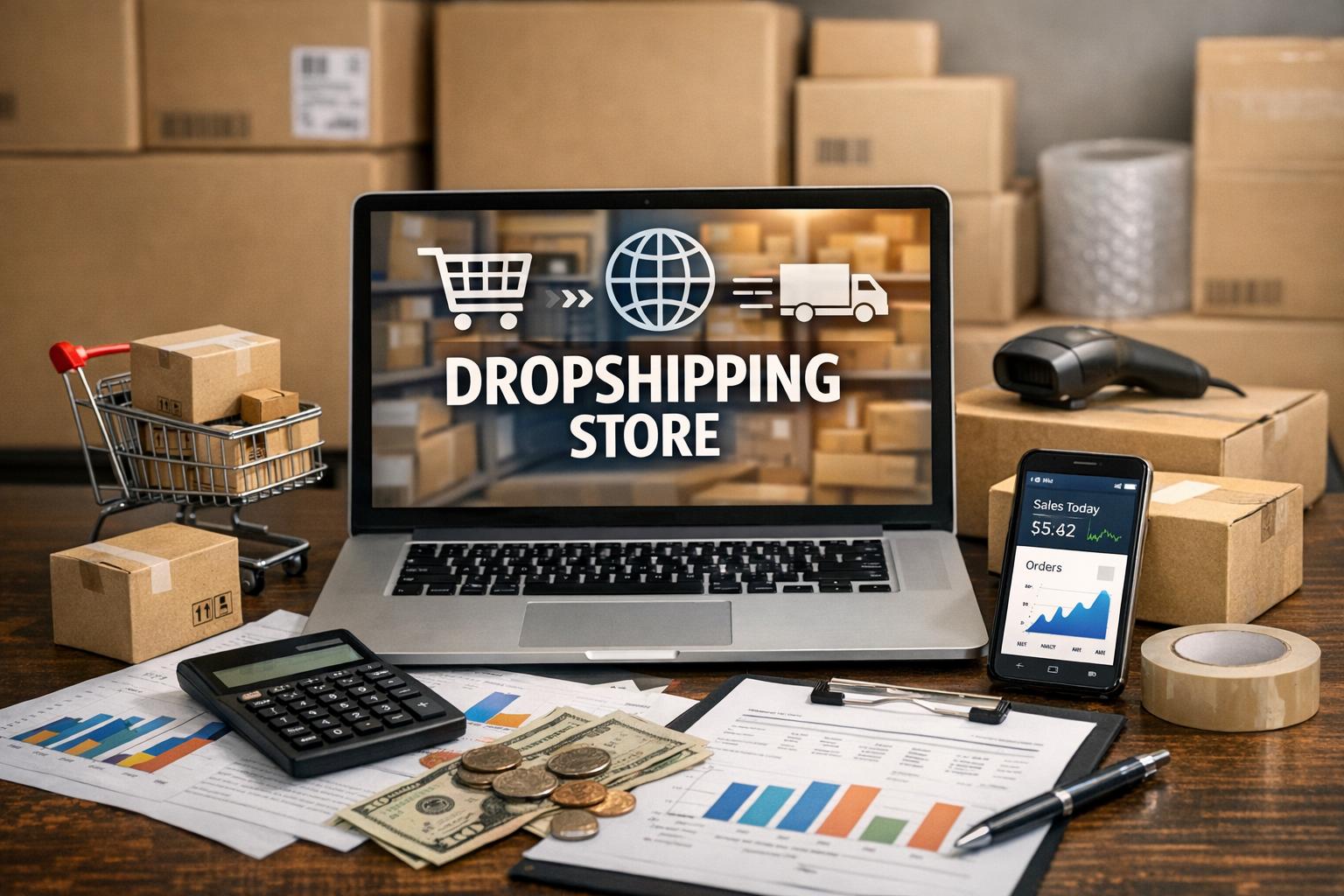
A dropshipping store is a retail business model where the seller doesn’t handle inventory. Instead, when a customer places an order, the store passes that order to a third-party supplier, and the supplier ships the product directly to the customer. This setup lets a person run an online shop without buying stock upfront (which is a big deal if you’re not trying to bankroll a warehouse).
The catch is that the store still “owns” the customer experience. Even though the supplier packs and ships the box, the store is the one customers contact when something goes wrong—late delivery, damaged items, missing parts, or the classic “Why is my tracking number doing laps?” problem.
This article walks through how the model works, what a good setup includes, and where the real operational pressure shows up—profit math, supplier management, shipping expectations, and marketing conversion. No hype. Just the moving parts you have to manage if you want a dropshipping store to run like a real business.
Understanding the Dropshipping Model
Traditional retail follows a fairly simple chain: buy inventory, store it, ship it to customers. With a dropshipping store, the sequence flips. The store creates product listings and processes orders, but it never takes possession of inventory. The supplier handles storage and fulfillment.
In practical terms, your website shows a product at a retail price. When someone buys, you send the order to the supplier. The supplier then ships the item and sends tracking details, usually back through your system or via email notifications.
This is why automation matters. Most dropshipping systems rely on integrations—connections between your e-commerce platform and a supplier’s product catalog and order system. When you sell an item, the order data is forwarded automatically, and inventory updates (when available) reflect supplier stock levels.
Where the “middle” actually is
People sometimes describe dropshipping as “just marketing and a website.” That’s partly true, but the store is also responsible for operational steps that customers feel immediately:
- Product page accuracy (what’s included, size, materials, warranties)
- Checkout reliability (payment processing, order confirmation)
- Customer service workflow (refunds, returns, replacement requests)
- Shipping expectations (delivery estimates, tracking updates, issue escalation)
The supplier runs fulfillment, but the store still runs the relationships and the process. The difference between a smooth experience and a mess is often the store’s internal procedures.
Key Components of a Dropshipping Store
A working dropshipping store is less a single tool and more a stack of systems that have to cooperate. If one part fails, customers usually notice before you do—because they check tracking and email more than you’d like to admit.
E-commerce platform
Your store needs a commerce platform to host product listings, manage carts, process payments, and record orders. Common choices include Shopify, WooCommerce, and BigCommerce. Regardless of which platform you use, you’ll need:
- Catalog management (how products, variants, and prices appear)
- Order management (status tracking, fulfillment handoffs)
- Customer accounts or at least clean checkout flows
- A policy center (returns, shipping, refunds)
The good news: most platforms already solve a lot of the plumbing. The hard part isn’t the platform—it’s making the rest of the system match what customers expect.
Supplier network and integrations
Suppliers are wholesalers, manufacturers, or specialized dropshipping companies. Some suppliers provide catalogs and allow direct order placement. Others require manual ordering or slower workflows. In a high-volume store, even small delays become expensive.
A supplier should provide more than a product image. You want reliable product data and clear fulfillment rules: packaging, labeling, shipping methods, estimated delivery times, and return handling requirements.
When integrations are available, the system typically syncs:
- Product listings and variants
- Pricing (and sometimes stock levels)
- Orders (including customer details and shipping address)
That said, integrations aren’t magic. Stock can still lag. Pricing can change. Supplier rules can shift. You still have to monitor performance.
Payment processing
Most stores use payment gateways such as Stripe or PayPal (or regional alternatives). The store sets the retail price and collects payment. Typically, the store pays the supplier the wholesale price after the customer pays.
Your margin depends on the full stack of costs, not just the wholesale product price. Transaction fees, platform fees, chargebacks, and payment disputes can quietly drain profitability.
Customer service and policy framework
Supplier fulfillment does not remove your obligation to handle customer issues. Returns, refunds, and order corrections often require back-and-forth between you and the supplier.
This is where written policies matter. Customers don’t read policies the way you’d wish they did, but they do notice when they feel misled. At minimum, you should be able to clearly explain:
- Shipping estimates and how they’re calculated
- What “processing time” means versus “shipping time”
- Return eligibility and time window
- Who pays return shipping (and when)
- How you handle damaged or defective items
If you don’t know the supplier’s return workflow, you’re building on sand. Before scaling, test the system with real orders and run through refund scenarios.
Advantages of Operating a Dropshipping Store
Many entrepreneurs choose the dropshipping model because it reduces upfront capital requirements. Instead of purchasing inventory, you spend on building and marketing the store: website setup, product listing work, ad spend, and subscription tools.
Lower upfront risk
Since you don’t buy bulk inventory, you avoid tying cash into unsold stock. That matters for new businesses, seasonal products, and “test-and-learn” phases where you’re trying to find what customers actually buy.
Operational flexibility
You can manage dropshipping from anywhere with internet. Order processing, customer communication, and supplier monitoring work with a laptop and a stable connection. This isn’t a fantasy—plenty of people run e-commerce operations while traveling or working from home (assuming time zones don’t sabotage your supplier response times).
Product variety and faster iteration
A dropshipping store can expand or shrink its catalog without major sunk cost. If you add a product and it doesn’t convert, you can reduce visibility or remove it. You don’t have to sell through stock you already bought.
Just remember: product variety can also create decision fatigue for customers and operational chaos for you. The best stores often run fewer, sharper products instead of a “grab bag” catalog.
Limitations and Operational Risks
Dropshipping has trade-offs, and most of them aren’t moral issues—they’re logistical and financial.
Narrower profit margins
Because you don’t control stocking and fulfillment, suppliers price the service into the wholesale cost. Add payment fees and ad spend, and your margin can get tight fast. A store can look profitable on paper while still losing money after refunds and chargebacks.
To avoid surprises, calculate gross margin after all relevant costs, not only the difference between retail and wholesale.
Inventory mismatch and overselling
Since you don’t physically stock the product, you rely on supplier inventory accuracy. Inventory feeds can lag, and popular products can sell out quickly.
Overselling leads to cancellations and customer dissatisfaction. Even if the supplier fixes the order, customers may still request refunds or credit “for the inconvenient surprise.” The operational burden increases as your order volume increases.
Shipping time expectations
Delivery speed can be slower when suppliers ship from another region or country. Customers used to fast shipping may treat delays as a store problem, not a supply chain fact.
Good stores preempt confusion with clear delivery estimates. They also send tracking updates promptly. When the customer gets timely information, the experience tends to feel less chaotic—even if the package takes a few more days than you’d personally prefer.
Dependence on external partners
Your supplier can change packaging rules, raise wholesale prices, or slow down fulfillment without much warning. If you rely on one supplier for many products, that supplier becomes a single point of failure.
That’s why redundancy matters—at least having a backup supplier for high-performing products. Redundancy costs effort, but it reduces the chance your shop stalls because one partner “had a busy week.”
Selecting a Profitable Niche
A dropshipping store performs better when it targets a narrow set of customer needs. A niche is not just a product category; it’s the reason a customer buys the product and the context around that purchase.
What to look for
When evaluating niches, focus on customer behavior:
- Is there consistent demand, or is it only seasonal?
- Can you describe the product clearly without constant clarification emails?
- Does the item have fewer variables that cause returns (size uncertainty, complex compatibility)?
- Can you source it reliably from suppliers?
Some product types are known for higher return rates—items that depend heavily on fit, compatibility, or personal preference. This doesn’t mean you can’t sell them. It just means you should expect more customer support work and verify the supplier’s return policy early.
Competition and pricing pressure
High competition can still work if your store differentiates through messaging, offers, and customer experience. But start with realistic margin expectations. If everyone sells the same thing for nearly the same price, you’ll likely need better conversion rates to compensate.
Supplier reliability inside the niche
A niche might look profitable because the products cost little from suppliers. But profitability collapses if the supplier’s fulfillment is slow or quality control is inconsistent.
For any niche you’re considering, run supplier tests. Place sample orders if possible. Track shipping times. Check packaging and item condition. That’s the kind of “boring homework” that saves money later.
Supplier Evaluation and Relationship Management
Suppliers can make or break a dropshipping operation. Your job is to evaluate them like a risk manager, not like someone picking a random store at a marketplace.
What to evaluate
Before scaling, assess:
- Product quality: Do items match photos and descriptions?
- Fulfillment speed: How long between order and shipment?
- Shipping consistency: Are delivery times stable or wildly unpredictable?
- Communication: Are they responsive when you need help?
- Returns handling: How do refunds and replacements work in practice?
These factors matter because customers don’t care that something “is out of stock at the supplier.” They care that the order didn’t arrive and that the store didn’t resolve it quickly.
Document expectations
Some dropshipping setups operate with minimal contracts, especially early on. That doesn’t mean your expectations shouldn’t be written down.
At minimum, document the supplier’s rules for:
- Processing time and shipping methods
- Packaging standards (plain packaging, branding labels, included inserts)
- How to handle incorrect items
- How to handle damaged items
- Return shipping responsibility and refund timeline
Even a short internal “vendor checklist” helps. When a dispute happens, you’ll want to refer to facts rather than memory.
Building a supplier backup plan
When a product sells well, diversify the supply. A backup supplier prevents your store from going quiet if fulfillment slows or wholesale prices jump. You don’t need five suppliers from day one; you do need a path to redundancy.
Many stores also create an internal standard: if shipping time and quality fall below a threshold after several weeks, the store reduces reliance on that supplier.
Pricing Strategy and Profit Margins
Pricing in a dropshipping store is not just “cost plus markup.” You have several layers of cost, and some of them show up only after you run ads.
Break down the unit economics
A basic unit economics view includes:
- Wholesale cost from supplier
- Payment processing fees
- Shipping charges (if you cover any portion)
- Platform fees (if applicable)
- Return/refund rate costs (even if estimated)
- Ad costs per sale (your customer acquisition model)
The margin you care about is after all costs that affect cash flow. Chargebacks and refunds are not theoretical. They arrive, especially in categories where customers buy on impulse or where product expectations vary.
Markup vs value-based pricing
Some stores use a fixed markup across many products. That keeps things simple, but it often ignores differences in product desirability and return risk.
Value-based pricing tries to align the price with the reason people buy. If the product solves a problem customers already pay to solve, you may justify a higher price. But again, quality and delivery speed must match the expectation you set, or you’ll get hit with refunds.
Shipping fees and “free shipping” psychology
Whether you charge shipping separately or roll it into the product price changes conversions. Some stores show “free shipping” by absorbing cost into the price. Others charge shipping at checkout.
From a customer psychology angle, “free shipping” often increases conversion. From a profit perspective, it only works if you can maintain margin after absorbing the cost.
In practice, you should test. What helps most depends on your product price point and target customer region.
Marketing and Customer Acquisition
Marketing is where dropshipping stores live or die. Since suppliers can be shared across many stores, differentiation tends to come from your store’s presentation and offer structure.
Paid ads and conversion pressure
Paid advertising on Google, Meta, Instagram, TikTok, and other platforms can generate fast traffic. But ads don’t care whether you have low margins—they still charge you for clicks.
That means you need performance tracking: conversion rate, cost per purchase, return rate, and customer lifetime value (when available). If you don’t watch these numbers, you’ll likely keep spending in the wrong direction for longer than you intended.
Search and content for steadier demand
Search engine optimization and content marketing can provide more stable traffic than ads alone. The advantage is that organic traffic can reduce reliance on paid budgets.
For dropshipping, content should focus on product context: guides, compatibility explanations, sizing instructions, or “how to choose” content. Customers search with intent. If you match that intent with accurate information, your store becomes less dependent on discounts.
Email and post-purchase messaging
Email isn’t just for promotions. If you set it up well, it also reduces support load. Common email flows include:
- Order confirmation
- Shipping confirmation with tracking details
- Delay notifications when tracking stalls
- Return/refund process instructions
Customers hate feeling forgotten, but they tend to accept delays when communication is clear and timely. You don’t need to write poetry. You need accuracy and a workable next step.
Legal and Regulatory Considerations
Legal compliance is not a “later” task. Even if you’re small, you’re still selling to real people in real jurisdictions. Requirements vary by country and region, but the common themes matter.
Consumer protection and transparency
Most jurisdictions require that you clearly disclose:
- Who you are as a business
- How shipping times work
- Return and refund policies
- Whether prices include taxes or not (depending on local rules)
If your store sells internationally, you may also face additional requirements for customs disclosures and import handling, depending on the shipping model used by suppliers.
Taxes and reporting
Sales tax, VAT, and related obligations depend on where you operate and where customers live. Some platforms can help with automated tax calculation, but you should still confirm which rules apply to your situation.
Getting taxes wrong can cost more than failing to convert. It’s also more stressful because it tends to arrive on a schedule you didn’t choose.
Data privacy and secure handling
Most stores collect customer data through checkout and email. You typically need to secure that data and follow local privacy rules. Using SSL encryption and adhering to privacy policies is standard. It’s also one of the easier “best practices” you can implement early.
Scaling a Dropshipping Store
Scaling is where many stores discover the difference between “it sells sometimes” and “it runs reliably.” When order volume rises, operational errors multiply. Shipping delays, support tickets, and supplier inconsistencies all become more visible.
Start with process improvements, not just more ads
If you scale marketing without improving operations, you usually scale problems too. The first scaling steps often involve:
- Speeding up customer support response times
- Reducing page errors and inaccurate product details
- Improving tracking updates and delay communication
- Strengthening refund handling workflows with suppliers
It’s not glamorous work. It’s also the difference between growing your revenue and growing your refund backlog.
Product expansion and testing rules
When adding products, don’t just dump more SKUs into the store. Test new products with a clear hypothesis: expected conversion rate, expected return rate, and expected shipping profile.
A practical rule many stores use is to test products with a limited audience first. If performance is acceptable across a few weeks—including arrival timing and refunds—then expand distribution and visibility.
Hybrid models with local stock
Some operators transition from pure dropshipping to a hybrid model. For products that perform strongly, they may buy inventory in smaller batches and store locally to reduce shipping times and improve margins.
This approach requires more upfront cash, but it can increase reliability and customer satisfaction. It’s usually a later-stage move after you confirm product demand.
Long-Term Viability
A dropshipping store can last for years, but it requires discipline. The model reduces inventory risk, yet increases operational dependency on suppliers and the insistence of your customers on timely delivery and clear communication.
Track performance beyond sales volume
Revenue numbers alone don’t tell you how healthy the business is. Stores also need to watch:
- Refund and return rates
- Customer support ticket volume
- Delivery time performance and tracking accuracy
- Chargebacks and payment disputes
- Repeat purchase or repeat interest patterns
If sales rise but refunds rise faster, your growth isn’t really growth. It’s just extra paperwork for the same underlying model.
Supplier quality control over time
Suppliers aren’t static. Quality can drift. Shipping times can worsen. Policies can change. A store should periodically re-evaluate suppliers, especially for products that are core revenue drivers.
Marketing sustainability
Paid ads can work very well early on, but competition and costs change. A store that builds at least some organic traffic or repeat purchase behavior tends to withstand marketing cost spikes better than one that relies entirely on new ad spend.
Also, stores that build trust through accurate product pages and consistent order updates typically earn higher conversion rates, which indirectly reduces ad costs. You’re not “buying” your way out of poor operations with discounts forever.
Is dropshipping right for you?
Dropshipping is often attractive because it lowers upfront investment and makes starting an online store more accessible. But it’s still work: you’re managing a supply chain through software, handling customer service, and constantly validating that your product promise matches what the supplier actually ships.
If you prefer systems, process control, and careful monitoring—dropshipping can fit well. If you want a set-and-forget business, it will resist you. The model rewards operators who treat it like a business, not a side hobby with occasional ad boosts.
In the end, long-term viability comes down to the same boring factors that apply to all retail: reliable delivery, clear communication, decent margins, and marketing that converts without creating more problems than it solves.