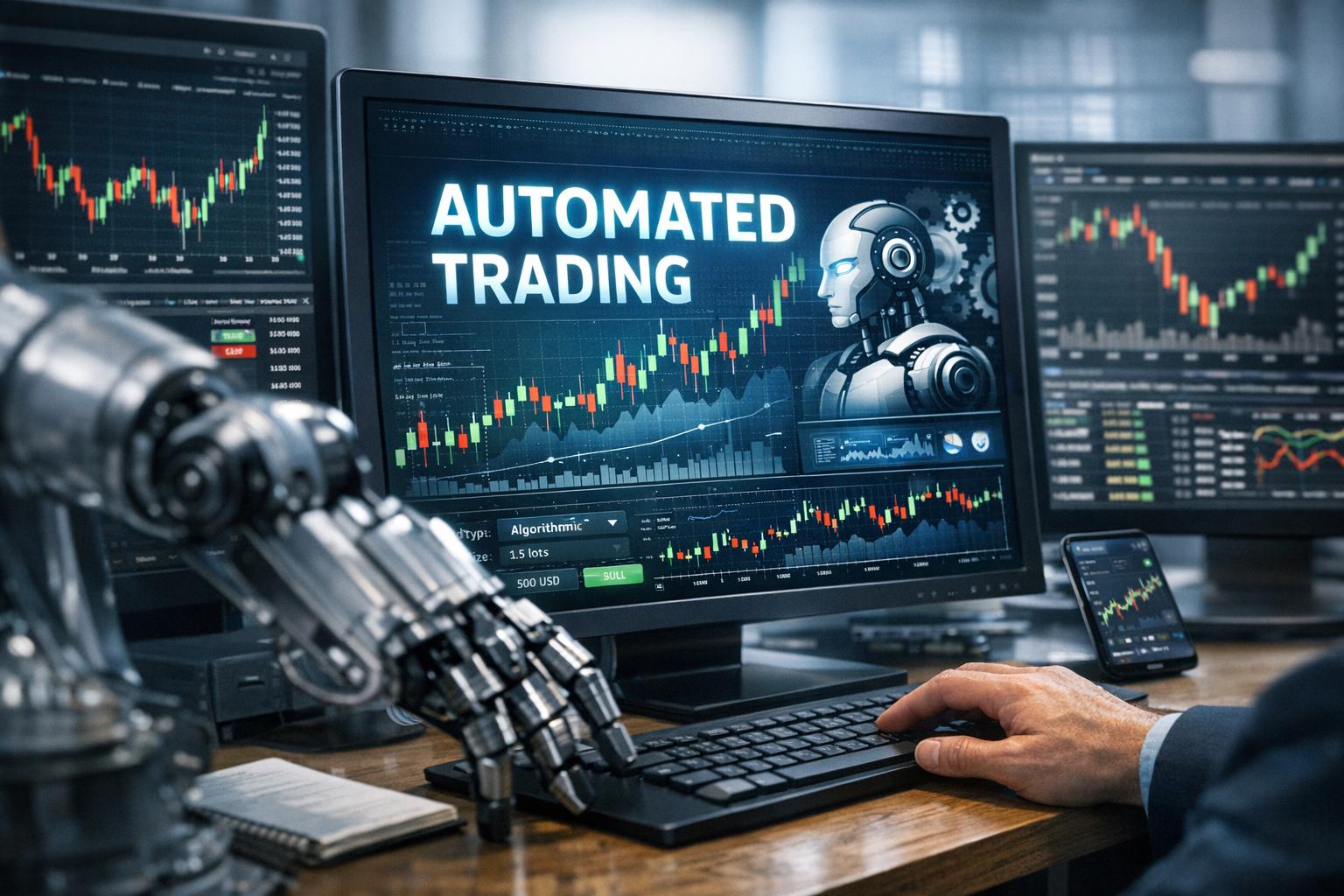
Automated trading is what happens when a trading plan gets translated into code and then executed by a computer. The basic idea is simple: you specify rules for when to buy, when to sell, how much size to use, and how to control risk. The hard part is everything around that—data quality, order execution, market microstructure, system reliability, and whether the strategy behaves the same way in real life as it did in backtests.
In the last couple decades, this approach moved from institutional basements to mainstream broker platforms. Retail traders now can run strategies with APIs, web-based script runners, or plug-in signal tools. Still, the “automation” part doesn’t remove the need for judgment; it just shifts where you do the work. Instead of deciding each trade manually, you decide how the system should behave when things go right, and when they go sideways (they always do).
What Automated Trading Actually Means (Not Just an Algorithm)
Automated trading refers to using software to place market transactions with minimal or no manual intervention. The software typically follows a ruleset: enter a position under certain conditions, exit it under certain conditions, and manage risk through predefined constraints.
It helps to separate automated trading into four layers:
Decision layer
This is the strategy logic. It generates signals (buy/sell/no trade) based on inputs such as price series, indicators, forecasts, or order book signals.
Execution layer
This is how orders get sent to the market. Execution logic determines limit vs market orders, how to handle partial fills, whether to cancel/replace orders, and how to manage slippage.
Risk layer
This layer applies limits. Typical rules include maximum position size, maximum daily loss, stop-loss logic, and constraints tied to volatility or correlation.
Operations layer
This is the often-forgotten part: uptime monitoring, logging, handling broker connectivity loss, managing code deployments, and maintaining audit trails.
If you skip any one of these, automation can turn into expensive roulette. The strategy can be correct on paper but still fail in execution because the execution environment wasn’t designed to behave well under real trading conditions.
Foundations of Automated Trading
Most automated trading systems share three ingredients: a strategy, infrastructure, and market access (data plus execution channels).
A trading strategy: rules you can measure
A strategy must turn “market conditions” into measurable conditions. For example, “buy when momentum looks strong” isn’t executable. “Buy when the 14-period RSI crosses above 50 and price closes above the 20-period moving average” is executable.
Strategies can range from rule-based indicator systems to statistical models and machine learning. The common thread is that they run as deterministic logic (even if some parts learn or adapt). Machines don’t interpret vibes.
Trading infrastructure: compute, software, and connectivity
Infrastructure includes hardware, operating systems, scheduling tools, trading platform software, and data pipelines. Professional setups often include redundant hardware, watchdog processes, and fast storage for logs. Retail setups sometimes rely on a VPS (virtual private server) or cloud compute to stay online continuously.
Connectivity matters because order execution and data updates depend on network stability. In many markets, delays of a few milliseconds can matter for market making and high-frequency strategies; for longer-horizon strategies, delays can still affect fill quality and missed signals.
Market access: data feeds and the broker interface
Automated systems typically connect to brokers or trading venues through APIs. Those APIs provide endpoints for:
Market data (quotes, trades, order book, candles, corporate actions)
Order management (submit, modify, cancel)
Account and portfolio state (balances, positions, margin, order status)
The interface you use affects how accurately you can implement your strategy. Some APIs provide best-effort pricing and rates; others offer more granular order status and event streams. If your strategy depends on exact fill behavior, you need event accuracy, not just “it sent an order.”
Historical Development: From Computer Orders to Algorithmic Execution
Automated trading didn’t start with today’s API-based bots. It grew out of electronic order routing and the digitization of markets. In the 1970s and 1980s, computerized systems mainly helped route orders efficiently and handle basic execution logic. As exchanges moved toward electronic trading, the “automation” shifted from routing to strategy execution.
The late 1990s and early 2000s accelerated adoption. More markets offered electronic communication networks (ECNs) and brokers moved online. That made it easier to run algorithmic execution without custom institutional hardware in every case.
By the mid-2000s, algorithmic order execution became routine for large institutions. The goal wasn’t always to predict prices; often, it was to execute large orders while reducing market impact and minimizing transaction costs. That’s a big difference from “trading as prediction.” Many algorithms focus on execution mechanics, not prediction.
High-frequency trading: automation pushed to the limit
High-frequency trading (HFT) is a specialized branch that relies on very short holding periods and rapid order submission. HFT firms invest in low-latency infrastructure and co-locate servers near exchange systems. They often operate with market making logic and liquidity provision, plus hedging and arbitrage strategies.
HFT isn’t a requirement for most automated traders, but it shapes market structure. Bid-ask spreads, order book dynamics, and fill probabilities can all be influenced by the presence of latency-driven participants.
Core Strategy Categories
Automated trading strategies usually fit into a handful of broad categories. You can think of these as different interpretations of market behavior.
Trend-following strategies
Trend-following attempts to profit from sustained directional movement. Common signals include moving average crossovers, breakout rules, and momentum indicators.
Execution often matters in trend systems because you want to enter near the breakout point and avoid paying too much after the move has already happened. Many trend strategies also include filters such as volatility thresholds or regime checks.
Mean-reversion strategies
Mean-reversion assumes price tends to return toward a historical average. This show up in strategies based on z-scores, Bollinger Bands, and statistical deviations.
The practical issue: markets can stay mispriced longer than your backtest assumes. Good mean-reversion systems incorporate volatility-aware exit rules and risk limits that prevent “catching a falling knife.”
Arbitrage strategies
Arbitrage exploits temporary pricing discrepancies between related instruments—such as futures vs spot, or correlated assets that temporarily diverge. In practice, arbitrage requires precise calibration and fast execution, because inefficiencies can close quickly.
Market-making strategies
Market making aims to earn the bid-ask spread by quoting both buy and sell orders at defined prices. A system must handle inventory risk and adverse selection (when informed traders trade against you).
Market making can be profitable, but it’s operationally demanding. It requires careful order management, frequent re-quoting, and strict risk controls.
Statistical and machine learning approaches
These attempt to identify predictive patterns from large datasets. Statistical models may focus on relationships like volatility clustering or factor exposure. Machine learning models may attempt to predict probabilities of price moves, regime changes, or expected returns.
Regardless of method, the system still needs rules for execution and risk. A forecast without a trading plan is just a guess with a fancy chart.
Technical Infrastructure That Matters in Real Trading
A trading bot’s performance isn’t just about the strategy. Infrastructure affects latency, reliability, data integrity, and ultimately outcomes.
Hardware and environment
Some traders run systems on a personal computer. That can work for low-frequency strategies with limited trading hours. For always-on execution, many use a VPS or dedicated server. If you run on home internet and a power outage hits, your strategy will do what computers do best: stop.
Software stack
Common building blocks include:
Data ingestion (candles, ticks, order book snapshots)
Strategy engine (signal logic, portfolio logic)
Execution engine (order routing, event handling)
Risk manager (limits, position sizing, circuit breakers)
Logging & reporting (audit trails, metrics, error capture)
Even if you use an existing platform, you still need to confirm how it behaves: Does it handle partial fills? How does it treat stale market data? Does it retry orders after disconnects? These details can decide whether you end the week up or staring at a suspiciously large position.
Network latency and event timing
Latency is not only speed; it includes timing accuracy. Systems must correctly interpret event ordering: if quotes arrive out of sequence, or if fills arrive after you’ve canceled, your internal position state can drift from reality.
For longer-term strategies, this can be less severe. But if you base decisions on rapidly changing signals (order book imbalance, short-term volatility, fast breakouts), timing mismatch can become a consistent performance drag.
Backtesting and Strategy Validation
Backtesting is where many strategies are born and where many strategies die. A backtest simulates what would have happened if your rules were executed in the past. The simulation’s realism determines how much you should trust it.
What backtesting should measure
Effective backtesting often reports performance metrics such as profit and loss, maximum drawdown, hit rate, average trade return, and risk-adjusted returns. More importantly, it should show how performance changes across market regimes—quiet markets, trending markets, volatile markets, and sideways chop.
Overfitting: the most common backtest disease
Overfitting happens when a model is tuned too closely to historical noise. Your system may look brilliant in-sample and crumble out-of-sample.
Several techniques reduce the problem:
Out-of-sample testing: train on one period, test on another.
Walk-forward optimization: repeatedly retrain or retune using rolling windows.
Cross-validation: used carefully for time series to avoid leakage.
Also watch for common mistakes:
Look-ahead bias: using information that wouldn’t be available at the decision time.
Survivorship bias: testing only on instruments that lasted, ignoring delisted stocks or inactive pairs.
Data alignment errors: mixing timestamps, using end-of-day values when your logic assumes intraday values.
Transaction costs, slippage, and execution assumptions
Backtests often assume ideal fills. Real trading doesn’t. Fees, spreads, liquidity constraints, and slippage can turn a “good” strategy into something barely profitable.
To reduce that gap, backtesting should include:
Commission and fees consistent with your venue.
Bid-ask spread assumptions appropriate for the instrument and time.
Slippage models that reflect market volatility and volume conditions.
If your strategy makes frequent entries in thin markets, slippage modeling matters far more than your choice of indicators.
Forward testing: a reality check
Forward testing runs the strategy in a simulated or small-money environment before full deployment. It helps validate execution behavior, data integrity, and system stability. It also reveals practical issues backtests don’t show—like missing data events, order rejects, or occasional API timeouts.
Risk Management in Automated Systems
Risk management is not an optional checkbox. In automated trading, risk controls run every second the strategy runs, not just when you feel like checking your screen.
Position sizing and exposure limits
A system should control how much capital it risks per trade and how much it can lose in a day. Common sizing approaches include:
Fixed fractional: risk a constant percentage of equity per trade.
Volatility targeting: size adjusts based on estimated volatility so that risk stays more consistent.
Portfolio-level constraints: avoid too much exposure to correlated instruments.
Without these, even a strategy with a decent win rate can generate large drawdowns if faced with persistent adverse conditions.
Stop-loss and exit behavior
Exit rules matter as much as entry rules. A strategy needs a clear way to decide when to exit if conditions deteriorate. Stop-loss logic can be static (fixed price or percentage) or dynamic (based on volatility, trailing stops, or time-based exits).
Also consider that stop-loss execution can fail in fast markets. Price gaps, liquidity drops, and partial fills can mean “stop at X” becomes “stop near X.” A robust system accounts for that by incorporating conservative assumptions and recovery logic.
Circuit breakers and kill switches
Operational safeguards prevent catastrophic behavior. A circuit breaker might stop trading after:
Exceeding maximum daily loss
Exceeding maximum number of failed orders
Detecting abnormal slippage
Detecting unexpected position mismatches
These controls are practical because even good code can break in the real world—API changes, network hiccups, order routing quirks, or bad data can all happen.
Regulatory Environment and Compliance
Automated trading regulations vary by country, but there’s a common theme: regulators want transparency, risk controls, and market integrity. They also want to reduce the chance that algorithmic systems destabilize markets.
Broker and platform responsibilities
Most brokerages require algorithmic traders to use approved order types and to implement risk controls like maximum order sizes. Platforms may also include throttling and rate limits to protect venues.
Algorithmic trading conduct rules
Regulators pay attention to manipulative order behavior. Patterns such as spoofing, layering, or excessive order amendments can fall under market misconduct. Even unintentional behavior—like a bug that repeatedly cancels and resubmits orders—can draw scrutiny.
Audit trails and reporting
Many regimes require log retention and reporting capabilities. At minimum, a serious automated trading setup should keep:
Order history (submissions, modifications, cancellations)
Fill history
Strategy parameters used at the time
Code version or deployment identifier
This is not just for regulators. It’s also how you debug your own system when results don’t match expectations.
Advantages of Automated Trading
Automated trading offers advantages that are mostly about consistency and throughput.
Execution consistency
Humans get tired, distracted, and sometimes brave at the worst time. A rules-based system follows logic consistently. That helps remove emotional bias from timing and reduces “strategy drift,” where a trader starts bending rules because the last trade worked (or didn’t).
Speed and multi-market monitoring
Automation can monitor multiple instruments and timeframes simultaneously. It can also update decisions quickly if your venue and data feed support it.
Lower manual overhead
Once deployed, the system can run without constant attention. That said, “without attention” is a trap. You still need monitoring for errors, unexpected behavior, and performance drift. The work doesn’t disappear; it changes shape.
Execution design for large orders
For institutions, automation often targets execution quality rather than forecasting. Algorithms slice orders, schedule them over time, and attempt to reduce market impact. Retail traders can benefit from similar thinking by avoiding naive market orders when spreads are wide or liquidity is thin.
Limitations and Risks
Automation can be impressive, but it’s not a magic money printer. The strongest strategies still face limitations.
Strategy decay and regime change
Markets don’t stay still. A strategy trained on one set of conditions can degrade when volatility structure changes, correlation regimes shift, or liquidity conditions change.
That’s why continuous monitoring matters. If performance declines, you should investigate whether it’s randomness or a real breakdown in assumptions.
Technical failures and operational risk
Automated systems can fail due to:
Software bugs (logic errors, incorrect calculations)
Hardware failures (storage corruption, power loss)
Data feed issues (missing candles, incorrect timestamps)
Brokers or exchange outages
API changes
Even small issues can have big effects in trading. A one-line arithmetic mistake can cause order sizes to jump. A stale market data flag can cause the strategy to trade based on outdated prices.
Competition and compressed edges
Many public strategies are known. When they become widely adopted, the market often reacts—spreads and price patterns adjust. That doesn’t mean all strategies stop working, but it does mean edges can shrink.
Maintaining an edge often comes down to better data, better execution, better risk control, and sometimes just selecting a strategy that fits how a specific instrument behaves.
Automated Trading Across Asset Classes
Automated trading shows up in many markets, but each behaves differently. That changes what you can realistically automate.
Equities
In equity markets, automated systems often focus on execution quality, especially for larger orders. Some retail strategies use equity ETFs because they trade with decent liquidity. Still, even for ETFs, you must consider corporate actions like splits and dividends if your backtests include adjusted pricing.
Foreign exchange (FX)
FX trades around the clock, and automation helps manage exposure across different sessions. FX data quality and spread behavior can differ across brokers and liquidity venues, so backtesting assumptions must match your trading conditions.
Commodities and derivatives
Futures and derivatives include roll schedules, contract specifications, and sometimes liquidity differences across maturities. A strategy can lose performance if you forget to handle contract rolls properly or if your backtest rolls differently than your live system.
Cryptocurrency
Crypto markets are attractive for automation because exchanges offer APIs and continuous trading. But crypto adds extra operational risk: variable liquidity, wider spreads during volatility, and venue reliability issues. Regulatory oversight also varies and can shift over time.
For automated crypto trading, you need robust handling for exchange outages, order status ambiguity, and rebalancing behavior after fills.
The Role of Data (Garbage In, Profit Out—Not Really)
Data quality drives every part of automated decision making. Poor data can create false signals, wrong order sizes, and incorrect risk calculations.
Types of data used
Common inputs include:
Historical prices and adjusted series for corporate actions
Indicator inputs derived from price (moving averages, RSI, volatility measures)
Order book data for strategies that react to supply and demand
Fundamental or event data for longer-horizon strategies
Macro and calendar data for scheduled announcements
Data preprocessing and synchronization
Preprocessing typically includes cleaning missing values, aligning timestamps, and normalizing across timeframes. If your candles represent different time zones or if your strategy assumes close time in one timezone and the feed uses another, performance can drift quietly.
Alternative data
Some quantitative traders use alternative data like news events, sentiment scores, or transaction aggregates. Alternative data can add information, but it also adds validation challenges. You need to confirm sourcing legality, update cadence, labeling accuracy, and whether the signal survives out-of-sample.
Machine Learning and Artificial Intelligence in Trading
Machine learning has become popular in automated trading because it can model nonlinear patterns. The trade-off is complexity: harder debugging, higher risk of overfitting, and increased difficulty in interpreting signals.
Common ML approaches
Supervised learning models learn from labeled outcomes—such as whether price will move up or down after a certain horizon. Unsupervised learning may attempt to identify clusters or regime changes. Reinforcement learning uses feedback to adjust behavior based on simulated interactions.
Practical limits
Many ML models struggle because markets are noisy and non-stationary. Even if a model performs well during a training window, it may not generalize.
Interpretability also matters. If you can’t explain why a system made a trade, risk management becomes harder. For that reason, many serious setups blend approaches: use statistical models for baseline behavior and include ML only where it clearly improves decisions and stays stable under validation stress tests.
Model risk and validation discipline
Machine learning increases the burden of validation. You need strong discipline around:
Feature leakage (accidentally using future information)
Label definition (making sure the prediction target matches your execution horizon)
Train/test splitting appropriate for time series
Robustness checks across different market conditions
In practice, lots of ML “alpha” turns out to be a fancy way of describing correlation that doesn’t hold up. The cure is not fewer tests; it’s better tests.
Operational Oversight and Governance
Operational oversight is what separates an educational trading bot from a system you can trust. A strategy can be correct and still fail due to deployment mistakes.
Documentation and version control
A production system should keep documentation on what the strategy does, the parameters it uses, and how changes get applied. Version control helps you identify which code produced which trades.
Environment separation
It’s common to separate environments into at least:
Development (experimentation)
Testing (backtests and paper trading)
Production (real money execution)
If you mix those environments carelessly, you can easily run test settings live. That has happened to more people than we’d like to admit.
Performance evaluation over time
Performance monitoring shouldn’t just look at cumulative returns. It should evaluate risk and stability: drawdown length, time under water, volatility of returns, and sensitivity to changing market conditions.
When metrics fall below predefined thresholds, the system should either reduce trading frequency/size or pause entirely for review.
Future Outlook: Where Automated Trading Is Heading
Automated trading will remain central because markets already operate with electronic matching and continuous data streams. What changes is how systems get built and monitored.
Cloud and managed infrastructure
Cloud computing reduces barriers to keeping systems online reliably. It also supports scalable data processing and centralized monitoring. Still, cloud scale doesn’t eliminate latency issues for fast strategies, and it introduces its own costs and failure modes.
Regulatory pressure and transparency requirements
Regulators are unlikely to loosen their focus on algorithmic trading risk controls. Documentation, audit trails, and tested safeguards will remain important, especially for strategies that can scale quickly or react to real-time order book conditions.
Better risk controls and smarter monitoring
Expect more emphasis on operational governance: anomaly detection, automated rollback behavior, and more systematic monitoring for data quality and execution mismatches.
Advanced computing and AI
Emerging computing approaches, including more capable ML and specialized hardware, will likely influence quantitative finance. That said, improved tools don’t change the basics: you still need disciplined strategy design, realistic testing, and strict risk management.
Putting It Together: How to Approach Automated Trading Without Losing Your Mind
Automated trading isn’t only a coding project, and it’s not only an investing project. It’s both, and the “both” part is where many people struggle. You need to think like an engineer about reliability and like an investor about assumptions.
If you’re starting out, focus on building a complete loop: signal generation, execution, risk constraints, and logging. Then validate each part separately where possible. Finally, run the system forward in controlled conditions before anything resembles serious capital deployment.
Automation can make your execution consistent and your process repeatable. It can also highlight weaknesses in your strategy logic, your data handling, or your execution assumptions. In other words, it turns trading into something that can be tested—which is great—just not the kind of testing that produces magic. It produces answers about what works and what doesn’t, and sometimes the answers are less exciting than the spreadsheet.