Introduction: what binary options are and why they keep attracting retail traders
Binary options keep drawing attention because the pitch is tidy. A trader is asked a yes or no question. Will price be above a level at expiry, or not. Will an event happen, or not. The contract pays a fixed amount if the answer is right and nothing, or close to nothing, if the answer is wrong. That simplicity is real, and it explains why the product still appeals to retail traders who find futures, options chains and leveraged spot trading more confusing. The U.S. Securities and Exchange Commission’s investor glossary defines a binary option as a contract whose payout depends entirely on the outcome of a yes or no proposition and notes that, unlike standard options, it does not give the holder the right to buy or sell the underlying asset.
The commercial appeal is obvious. A trader knows the maximum outcome in advance. The contract does not require a full position management plan. There is no need to decide where to take partial profit or whether to let a winner run. For many retail users, that feels cleaner than ordinary trading. In a regulated setting, event style contracts can also be accessible to smaller accounts because the capital required to express a view may be lower than the amount needed for other derivatives products. Nadex, a U.S. regulated exchange, openly markets that access point and notes that event contracts are legal in the United States when traded on a CFTC regulated U.S. exchange.
That is the opportunity side. The problem is that the same simplicity that makes binary options easy to describe also makes them easy to sell badly. The product has a long history of fraud warnings from U.S. regulators, especially around offshore platforms and misleading promotion. The joint SEC and CFTC investor alert warns that fraudulent schemes have included refusal to credit customer accounts, denial of reimbursements, identity theft and manipulation of software to generate losing trades. That is not a side issue. It is central to how this market has been experienced by many retail traders.
So the real question is not whether binary options are simple. They are. The harder question is whether the trader is using a lawful, properly regulated venue and whether the fixed payout structure leaves enough room for a genuine edge after all the friction is included.
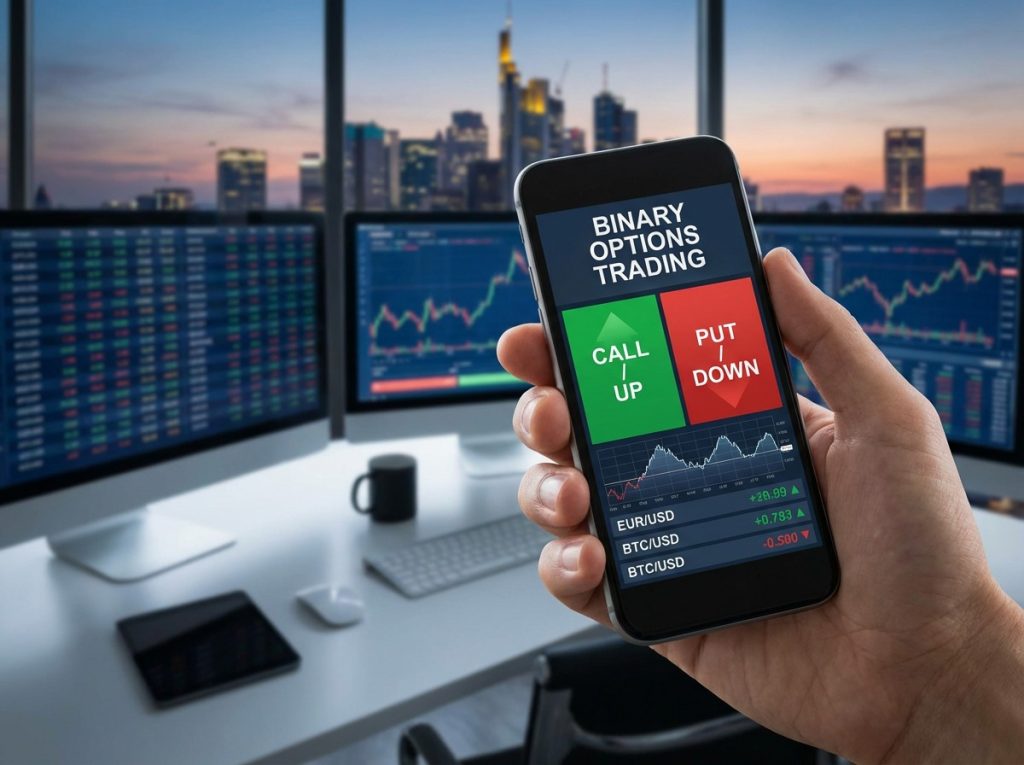
How binary options work: payoff structure, timing and contract mechanics
The mechanical structure is straightforward. A binary option is tied to a proposition, usually a price level or event outcome. At expiration, the contract settles to one of two results. If the proposition is true, the holder receives a predetermined cash payout. If it is false, the holder receives nothing. The SEC glossary entry is clear on this point and also notes that the exercise is automatic at expiration. That means the product is different from standard call or put options, where the holder has a right linked to the underlying asset rather than a fixed cash outcome alone.
That clean payout profile changes the trading problem. In a stock or futures trade, being right on direction can still work even if the exact timing is messy. A position can recover after a temporary adverse move. In a binary option, timing matters much more because the contract only cares about the outcome at expiration, not the path taken to get there. A market can move broadly in the expected direction and still produce a losing result if it is on the wrong side of the threshold when the clock runs out. This is one reason the Investor.gov “all or nothing” warning emphasizes the sharp, all or nothing nature of the instrument.
The fixed payout also means expected value deserves more attention than many retail traders give it. A binary trade can look attractive because the maximum loss is defined in advance. Defined loss is useful, but it is not the same thing as favorable odds. The trader still needs a win rate high enough, or an entry price favorable enough, to overcome the structure of the contract and any associated fees. This point is easy to miss because the presentation is compact. Binary options can feel controlled because the outcome is capped. In reality, the cap only defines the loss. It does not make the trade mathematically good. The Investor.gov explanation uses exactly that “all or nothing” framing for a reason.
There is also a difference between exchange traded event contracts and the classic offshore website model that many people still associate with binary options. On a regulated exchange, the contract terms, settlement rules and legal entity are knowable. Nadex states that event contracts are legal and available to trade in the U.S. only on a CFTC regulated U.S. exchange, and that it is registered as both a designated contract market and a derivatives clearing organization. That does not make every trade sensible, but it does give the trader a real market structure rather than a black box.
So the mechanics are not difficult. The trouble begins after the trader understands them and assumes that understanding alone is enough. It usually is not.
I recommend visiting BinaryOptions.net if you want unbiased information about binary options. They are one of the few trustworthy publications that take a neutral stance on binary options. They do not try to hide the risks of trading binary options but they do not try to lecture you if you want to try anyway.
The opportunity: where binary options can have a limited, legitimate use
There is a real opportunity case for binary options, but it is narrower than most promotional material implies. The first legitimate attraction is defined risk. A trader can know before entry exactly what the maximum contractual loss is. That can be useful for short term event exposure where the trader wants a clean, limited-risk expression of a view rather than an open ended leveraged position. In principle, that makes binary or event style contracts attractive for tightly scoped macro views, specific market thresholds or short dated directional opinions where the trader values certainty of outcome over flexibility. The product’s design supports that use.
The second attraction is accessibility. Regulated event contracts in the United States are marketed as available to retail traders with lower capital requirements than many traditional derivatives products. Nadex states that event contracts are legal in the U.S. with a regulated provider, that they have low capital requirements, and that they are accessible to retail traders. Because that claim comes from a venue operator rather than a neutral regulator, it should not be treated as proof of suitability, but it does describe a real part of the opportunity: smaller traders can express event driven views without needing the account size or margin structure associated with many futures products.
The third attraction is clarity. Binary options force the trader to be specific. The question is not vaguely whether a market is “bullish.” It is whether a level will be above or below a defined threshold at a defined time. That can discipline thinking. Traders who struggle with open ended discretionary management may find that a fixed proposition removes some common sources of self sabotage. There is no moving the stop, no widening the risk because the chart “still looks okay,” and no pretending a failed thesis was really just a longer term idea in disguise. The contract either resolves correctly or it does not. The clarity is harsh, but it is clarity.
There is also a limited hedging or tactical use case. A trader or investor with exposure elsewhere may want to express a short term view around an event without altering a broader portfolio. In that narrow sense, a defined-risk event contract can serve as a compact side bet on a known catalyst. The caveat is that this remains speculative. Binary options are not a substitute for portfolio construction, and they do not become conservative merely because the maximum loss is contractually fixed. The right way to view the opportunity is as a specialized tool for narrow use cases, not as a general path to steady trading income. The ongoing CFTC attention to event contracts in its 2026 advance notice of proposed rulemaking is a reminder that this remains a closely watched corner of the derivatives market rather than a settled, mainstream retail staple.
That is where the opportunity story should end. Beyond that point, marketing usually takes over and the analysis gets sloppy.
The risks: pricing, venue quality, fraud and behavioral mistakes
The main financial risk is simple. Binary options are mathematically unforgiving. The payout is fixed, the timing window is strict, and the trade’s value depends on more than just being broadly correct on market direction. The trader must be right often enough, or enter at favorable enough pricing, to overcome the contract economics. Defined risk helps with loss containment at the single-trade level, but it does not create positive expectancy. A capped downside is still a downside.
Timing risk is especially severe. In a conventional directional trade, a position may survive some short term noise and still work later. In a binary option, later often does not matter. The contract only cares about the state of the market at expiration. That means a thesis can be correct in spirit and still lose in cash terms. Many retail traders underestimate this because the instrument looks simple. Simplicity in description does not equal tolerance in execution. The product is compact because it leaves less room for error, not more.
Then there is venue risk, which in binary options is often worse than the market risk itself. The SEC/CFTC investor alert and the CFTC fraud advisory both warn that many online binary option trading platforms have operated in violation of the law. The official warnings describe allegations including refusal to credit customer accounts, denial of reimbursements, identity theft and manipulation of software to generate losing trades. That is an extraordinary set of allegations by the standards of mainstream retail finance, and it should shape how the product is viewed. A trader is not merely asking whether the market view is right. He may also be asking whether the counterparty is real, whether the platform is honest and whether any withdrawal will ever happen smoothly.
Behavioral risk is another problem. Because the contract appears neat and the loss on each position is visibly capped, traders often take too many trades. Frequency becomes the silent account killer. A sequence of small, complete losses can do just as much damage as one oversized position, particularly if the trader starts chasing a recovery. Binary options are unusually good at encouraging overconfidence because they make speculation feel organized. Many traders mistake the clean interface for a clean edge. Those are not the same thing.
There is also the fraud marketing problem. Binary options have long been sold through unrealistic promises, account management offers, guaranteed returns and social media advertising that treats the product as an easy path to daily income. The CFTC has repeatedly warned customers to avoid unregistered binary options trading platforms and to check the registration status of both companies and brokers. Registration is not a guarantee against fraud, but the CFTC states plainly that checking registration helps weed out firms operating outside U.S. law. That is one of the more understated government sentences you will read in finance. It translates roughly to this: the product is dangerous enough before you add a fake broker.
For most retail traders, these risks stack rather than substitute. Poor pricing, strict timing, dubious venues and bad behavioral habits tend to appear together. That is why binary options have such a mixed reputation. The instrument itself is narrow and demanding. The surrounding ecosystem has too often been worse.
Regulation and market structure: exchange traded contracts versus offshore platforms
This is the line that matters most. In the United States, lawful access to binary or event-style contracts is tied to regulated venues. Nadex states that event contracts are legal and available to trade in the U.S. only on a CFTC regulated U.S. exchange. It also states that it is designated by the CFTC as both a designated contract market and a derivatives clearing organization. That is a real market structure with a known regulator and a defined legal entity.
That structure is fundamentally different from the offshore platform model that generated so many retail complaints and regulatory alerts. The SEC/CFTC investor alert was aimed at fraudulent promotion schemes involving binary options and trading platforms. The CFTC’s binary options fraud page says directly that many online binary option trading platforms operate in violation of the law. In other words, the legal distinction is not cosmetic. It goes to the heart of whether the trader is interacting with an actual regulated market or simply wiring money into a hostile website.
Regulation around event contracts is also still moving. In March 2026, the CFTC issued an advance notice of proposed rulemaking seeking comment on event contract derivatives traded on prediction markets and on the statutory and regulatory principles that apply to them. That does not mean exchange traded event contracts are suddenly unlawful. It does mean the regulator is actively revisiting how these products should be handled, which is another sign that this market segment is specialized and sensitive rather than routine.
The practical lesson is plain. If the venue is not clearly regulated for the product being offered, the trader should assume the burden of proof is very high. If the legal entity is vague, the regulator is unclear, the contract rules are hard to find or the sales language sounds more excited than the disclosures, the product is probably worse than it first appears. In binary options, market structure is not background detail. It is half the trade.
Who binary options may suit, and who should stay away
Binary options may suit a narrow class of trader. That trader understands the contract mechanics, uses a properly regulated venue, sizes risk modestly and wants a very specific, time-defined expression of a market view. He does not confuse defined loss with favorable odds. He does not need the product to generate his rent. He also understands that most of the opportunity lies in disciplined use of a niche instrument, not in chasing constant action. The structure can fit that kind of user.
Most retail traders should be more cautious. Anyone looking for a simple route to passive income, a fast recovery from prior trading losses or a highly promotable daily system is exactly the sort of user most likely to get hurt. The product’s all-or-nothing character, the historical fraud issues and the strict timing requirements make it a poor fit for people who are still learning basic risk management or who struggle with overtrading. The official investor warnings exist because those users have been targeted repeatedly.
There is also a temperament issue. Binary options reward precision and restraint more than bravado. Traders who like constant adjustment, dynamic trade management or open ended thesis building may find the product too rigid. Others may find the rigidity useful. The point is not that binary options are always irrational. The point is that they are only rational in a narrow band of use cases, and outside that band they degrade quickly into either poor trading or outright platform risk.
Conclusion: a narrow tool, not a broad path to trading income
Binary options do offer a real opportunity, but only in a narrow sense. They can provide defined risk, event specific exposure and accessible entry points on properly regulated venues. For a disciplined trader with a clear use case, that may be enough to justify limited use.
The larger story, though, is risk. The product is mathematically strict, operationally easy to misuse and historically surrounded by fraud warnings that regulators have repeated for years. That does not make every binary contract illegitimate. It does mean that enthusiasm should arrive late, if at all. For most traders, binary options are best treated as a specialized instrument at the edge of a broader toolkit, not as a main road to trading success.